Hi, Welcome to my blog. It will contain my latest sightings, links to my latest photos and info pages and any relevant news updates. It will be updated when possible.
56078+56105 and snow ploughs at Carlisle 21.9.26
Colas liveried 56078+56105 are seen sandwiched between a pair of independent snowploughs at Carlisle while working 7Z39 working to Eastriggs MOD 21.9.26 https://scottishtrains.zenfolio.com/p973715508/e6e943861


Glasgow Coronation 1245 at Summerlee 12.9.26
 On 12th September, I visited Summerlee Heritage Park in Coatbridge for their behind the scenes tour of their engineering facilities and stores of some of their artifacts that they have in storage.
Part of the tour took in the engineering workshops in which Glasgow Coronation Tram 1245 is nearing the end of a very long major overhaul, which will see the tram enter service at Summerlee at some point during 2027.
1245 is one of only 4 Glasgow Coronation cars still in existence and will be the only one in operation when it does return to service. The other three coronations are:
-
Coronation 1173, which is on static display at the Riverside Museum, Glasgow
-
Coronation 1274, which is on static display at the Seashore Trolley Museum in Maine, USA
-
Coronation 1282, which is on static display awaiting its turn in the restoration queue at the National Tramway Museum, Crich
Our guide for the tour of the workshops took us onboard and let us see the almost complete upper deck on 1245, which is in it's original art deco style and with its maroon coloured swing over seating! The lower deck is still undergoing some work and has yet to have its seating installed. Our guide told us that as a compromise from the original design, the lower deck will be fitted out with maroon leather swing over seats, the same as the upper deck instead of the original fabric moquette.
Our guide mentioned that it is expected that the tramway will reopen during 2027, having been closed for almost 4 years. Hopefully the reopening of the tramway along with the interest generated by the introduction to service of 1245 to complement other local cars Glasgow 1017 and Lanarkshire 53 and the proposed development and extension of the area around the Miners village will increase visitors to the museum.
A brief history of the Coronation Trams.
|
|
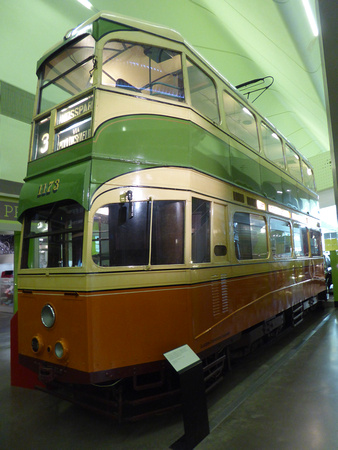
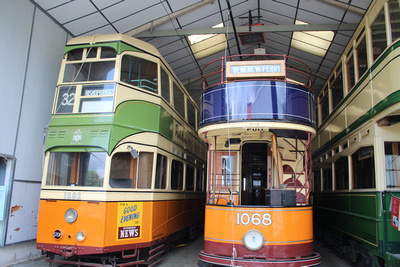 The Glasgow tram fleet of the mid 1930s mainly consisted three types of tramcar:
- The former Paisley and District tramcars, many of which had been cut down from open top double deck to single deck cars to operate on the Clydebank - Duntocher route
- The Kilmarnock bogie standard cars, 50 of which had been built in the late 1920s by Hurst Nelson but were limited to certain straighter routes such as service 9 from Auchenshuggle - Dalmuir West due to numerous derailments on tight curves.
- The predominant member of the fleet, however was the fleet of four wheel, single truck Standard double deckers, some of which dated as far back as the 1890s, however they were all built or refurbished to almost the same design and some of the more elderly Standard Cars were nearing the end of their service life and were costing almost as much to maintain as it would to build new tramcars.
The decision by Glasgow Corporation to build a new fleet of tramcars was taken primarily for two reasons:
- They needed to replace some of the oldest Standard class trams, many of which were life expired
- With Glasgow hosting the Empire Exhibition in 1938, they wanted to show Glasgow, the transport network and in particular a new fleet of trams that would be the envy of the visiting countries!
Approval for the building of a pair of prototype trams came in February 1936, with construction work beginning in late April 1936. The first of the prototype cars, numbered 1141, emerged from Coplawhill works in December 1936 ready for inspection by the Tramway Committee and entered service on 1st January 1937. The tram car was well received by the Tramway Committee, the press and the public, being described in one newspaper as being 'Undoubtedly the finest short stage vehicle in Europe'. The cost to build 1141 was £4406 (£404,206 in 2026 money).
 Some of the main features of 1141 were:
- Enclosed driving cabin with door, seat and heater, something which none of the previous cars had!
- Dipping headlights, sunshade, fog light, stop light, trafficators and retractable mirrors, all new features!
- The passenger saloons had 4 large windows
- Concealed lighting, with light up external 'Corporation Transport' text on the bodysides above the lower deck windows
- Art deco wall and ceiling panelling
- Moquette covered swing-over seating on the lower deck and leather covered swing over seating on the upper deck
- Air ventilation and saloon heating
- large 3 part destination screens
A second prototype car, 1142 entered service in March 1937 in a special livery to mark the Coronation of King George VI. The main differences between 1141 and 1142 were:
- 1142 had 5 main windows per side rather than four
- 1142 had Maley and Taunton swing bogies instead of EMB lightweight bogies on 1141
- The windscreen in 1142 was divided rather than a full windscreen on 1141
- Various interior differences
The design and shape of 1141 was chosen as the design and shape for the production cars minus some of the costlier features. One such feature that didn't find its way into the production models was a loudspeaker system after an unfortunate driver forgot to switch the speaker off and turned the air blue when a lorry got too close to 1141!
 An initial batch of 100 production cars were sanctioned with production starting in September 1937. The first 6 production cars, 1143 - 1148 were built and in service by December 1937, production was ramped up in 1938 and by the time of the Empire exhibition in mid 1938, 39 production cars were in service and by the end of 1938, 99 were built and in service! A further 25 cars were sanctioned in December 1938 and another in January 1939, bringing the total to 150. Most of the fleet had entered service by 1940, with the final car 1292 entering service in mid 1941.
The new fleet were initially called 'Saloon Cars' when introduced to service, however they were soon renamed Coronations, due to the Coronation of King George VI taking place in 1937. Initially the Coronations were allocated to Newlands and Maryhill depots, who provided the trams for Service 3 from University - Mosspark. Service 3 was the main route to the Empire Exhibition and there was also an extra service (number 30) which provided further capacity to the Exhibition.
After the exhibition ended, the Coronations were reallocated and spread out to other depots, operating on most services except service 12, 17, 19, 20, 22, 27 and 30 (the post war service, which is different from the special service 30 that operated in 1938). During wartime, the Coronation cars were moved away from depots near the Clyde or major works, in case the depots were targeted by enemy action.
A further 6 Coronation trams were built in 1954 to the same design as the production models but with a more austere interior. Unfortunately four of the cars were destroyed in the Dalmarnock depot fire in 1961.
Over the years of service, there was a few accidents and mishaps that caused damage to the fleet, however until 1957 all repairs were carried out, even if it involved major repairs, even rebuilding the body. Examples of this are:
- 1169: Burnt out in 1938 after a fire caused by a collision with a lorry, which resulted in the lorry's petrol tank exploding. 1169 was rebuilt and returned to service in 1939.
- 1275: Severely damaged in the Clydebank Blitz in 1941, rebuilt and returned to service
- 1141, 1148 and 1239 were rebuilt after being severely damaged in the Newlands depot fire in 1948
- 1279 had 2 major fires, which resulted in body rebuilds in 1948 and 1954
- 1255 caught fire after short circuiting at Coplawhill works
With abandonment of the tramway underway, major overhauls and rebuilds ceased from 1957 and when 1289 overturned on a sharp curve in 1958, it became the first Coronation tram to be scrapped. 1152 was scrapped a few months later following an accident. In 1959, 1145 was scrapped following a tragic and fatal accident which occurred when a lorry collided with the tram on Shettleston Road. The lorry severed the live cable, which started a major electrical fire which destroyed the tram and resulted in a modification to the fleet to introduce an extra circuit breaker to cut the feed in a collision.
20 Coronation trams were destroyed in the Dalmarnock depot fire in March 1961 and with the number of routes decreasing as abandonment gathered pace, withdrawals of the modern cars began in late 1961. By the closure of the tramway in September 1962, 45 Coronation Cars remained on the books of Glasgow Corporation, with 7 of them featuring in the last tram parade on 4th September 1962. 1174 was the final service tram to return to Dalmarnock depot on 4th September prior to the parade. Coronation 1282 also featured in Clydebank's last tram parade on 6th September.
 1245
1245
Coronation 1245 was built during the early months of 1939 and entered service, allocated to Parkhead depot on 29th May 1939. Based at Parkhead pre-war, 1245 would have operated services including 15a from Uddingston - Paisley, 29 from Tollcross - Anderson Cross and the two services, which would have 1245 passing very near it's current home: 15 from Coatbridge - Paisley and 23 from Airdrie - Kelvingrove. A reorganisation of the services to shorten and split them during World War 2 would have seen 1245 still operating on service 15 from Airdrie - Anderston Cross, 23 from Airdrie - Maryhill and 29 from Milgavie - Uddingston amongst others.
Into the 1950s as the tramway began to shrink in size, 1245 remained allocated to Parkhead Depot until it closed in March 1960, before transferring to Maryhill Depot. When Maryhill depot closed in October 1961, 1245 transferred to Dalmarnock depot and would have been a regular on the final three remaining services: 9 Auchenshuggle - Dalmuir West, 15: Ballieston - Anderston Cross and 26 Dalmarnock - Dalmuir West.
1245 was withdrawn from service in June 1962 not long after the withdrawal of
 service 26 (leaving only service 9 operational by this stage). Transferring to Coplawhill works, 1245 was used by the works department as a shunter to move withdrawn trams around the depot either for restoration work prior to the Last Tram parade, positioning for removal for preservation or in the case of most trams, for scrapping. 1245 was the final tram to move under it's own power, when it shunted sister car 1274 into the erecting shop at Coplawhill in February 1963, some 6 months after the tramway closed.
Preservation
1245 was bought for preservation in April 1963 by Adam Gordon and was transported south to the shortlived Midland Motor Museum in Measham, where it was displayed outdoors. 1245 was on the move again in 1965 and found a new home at the East Anglia Transport Museum at Carlton Colville in East Anglia. 1245 was operational for a time until a fire occurred in 1245's control system, rendering the tram unservicable. 1245 remained at Carlton Colville until 1998 when more space was required for the operational fleet, meaning a move to Rigby Road depot on the Blackpool tramway for further storage. 1245 remained at Rigby Road depot until 2002 when 1245 was transported north to Summerlee. A full and comprehensive overhaul and restoration job began in 2011 with work being carried out over a 15 year period, which will hopefully see 1245 grace the rails once again and carry passengers again for the first time since the 1960s!

|

|

|
| Coronation 1245 nearing the end of it's long term overhaul at Summerlee 12.9.26 | Almost complete top deck on board 1245 12.9.26 | Work in progress on lower deck of 1245 12.9.26 |
Great Orme Tram 5 22.8.26

My favourite shot from my brief visit to Great Orme Tramway as part of the SRPS Railtour on Saturday 22nd August! With a beautiful view of Llandudno Bay behind it, Hurst Nelson (Motherwell) built Tram 5 heads up the steeply inclined Ty-Gwyn Road towards Halfway 22.8.26
50050 at Carlisle 22.8.26
 BR Blue liveried 50050 'Fearless' pauses at Carlisle with 1Z25 6.10 Kirkcaldy - Llandudno 'The Thistle and Dragon' SRPS Railtour 22.8.26 https://scottishtrains.zenfolio.com/p368238696/h5E6CD93F#h5e6cd93f
Scottish Quartet of Adverts: Edinburgh Trams July 2026

|

|

|
|

A quartet of Scottish Adverts on Edinburgh's CAF Urbos 3 trams!
- Photo 1: Tram 253 advertising Loganair
- Photo 2: Tram 276 advertising Walkers Shortbread
- Photo 3: Tram 252 advertising the Scotland International Football Teams
- Photo 4: Tram 267 advertising Irn Bru
43138 tnt 43149 at Stirling 17.7.26
Scotrail Inter7city liveried 43138 and 43149 top and tail Mark 3 set HA03 at Stirling with 1T46 14.35 service from Aberdeen - Glasgow Queen Street 17.7.26

Great Orme Tramway 4.7.26
 The Great Orme Tramway in Llandudno is Britain's last street cable tramway and one of only a few left in the world.
 Construction work commenced in 1901 on the lower section, with this section opened on 31st July 1902 with the first passengers seen off by the town band playing 'God Save the King'. The track was laid to a gauge of 3ft 6in and had a conduit slot in the centre, under which there was the wires and pulleys used to haul the trams up and down the slope.
 The completion of the upper section was delayed and occurred almost a year after the lower section opened. The upper section opened with no fanfare on the 8th July 1903. The main difference between both sections was that the upper section was more of a tramroad with ballasted sleeper track with the pulleys and cables out in the open.
 The four passenger tramcars were built by Hurst Nelson of Motherwell in 1902, with cars 4 and 5 being delivered first for the opening of the lower section in 1902. Cars 6 & 7 arrived later for use on the upper section, which opened in 1903. All four cars have operated on the same sections for the entirety of their working lives on the tramway.
-
a pair of brake handles
-
a pedal to work the horn
-
a dead man's pedal
-
 a series of controls to allow communication with the Power House and Winchman.
 -
The lower section cars are also fitted with water tanks to allow the driver to spray water onto the track in certain conditions.
|
Number |
Name |
Built |
Type |
In Service |
Section |
Photo |
|
1 |
N/A |
1902 |
Freight |
Withdrawn/Scrapped by 1911 |
Both |
|
|
2 |
N/A |
1902 |
Freight |
Withdrawn/Scrapped by 1911 |
Both |
|
|
3 |
N/A |
1902 |
Freight |
Withdrawn/Scrapped by 1911 |
Both |
|
|
4 |
St Tudno |
1902 |
Passenger |
In Service |
Lower |
|
|
5 |
St Silio |
1902 |
Passenger |
In Service |
Lower |
|
|
6 |
St Seiriol |
1902 |
Passenger |
In Service |
Upper |
|
|
7 |
St Trillo |
1902 |
Passenger |
In Service |
Upper |
|


73129 at Cambrian Heritage Railway 2.7.26
BR Blue liveried 73129 'City of Winchester' is seen stabled at Oswestry station on the Cambrian Heritage Railway 2.7.26

Class 110 at Llangollen Railway 1.7.26
The superbly restored British Railways Green liveried class 109 (E50416 + E56171) is seen both at Llangollen and Corwen East 1.7.26

|

|

|

|

|

|
Classes 142, 143 and 144 at Cambrian Heritage Railway, Oswestry.
The Cambrian Heritage Railway has their main headquarters at Oswestry on the border of England and Wales. Part of their fleet of heritage trains are four pacers from 3 different classes!
The Pacer fleet consists of:
- Northern liveried 142004, one of the final Class 142s to be withdrawn from mainline passenger service
- GWR liveried 143619, which would have worked on local lines around Exeter in its final years of service
- Northern liveried 144006 & 144007, which would have been used around the Yorkshire area
Here are a few images of them at Oswestry

|

|

|

|

|

|